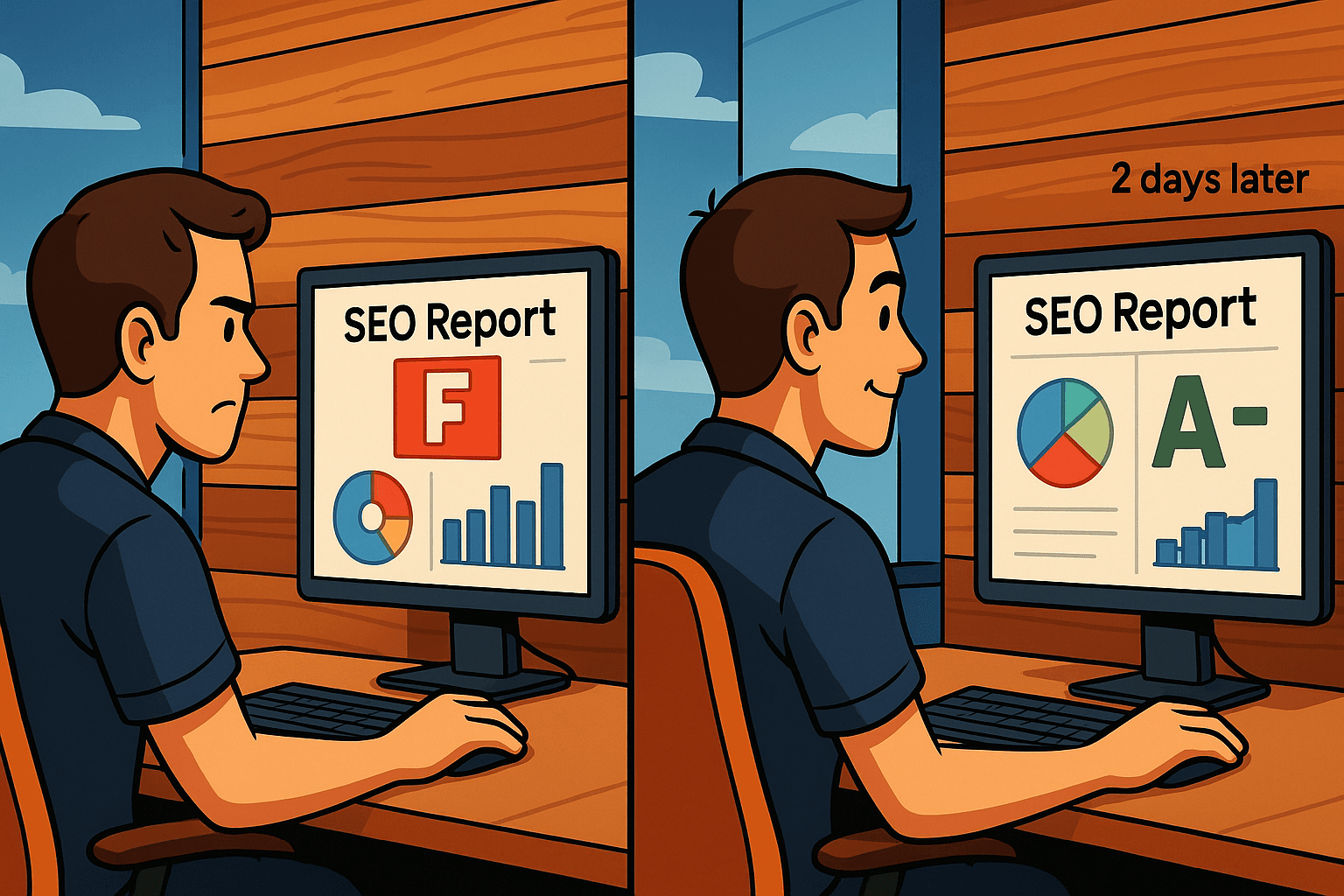
How AI Taught Us SEO While We Rebuilt Our Site
Two weeks ago, we couldn't find our own website on Google. Today our search foundation grades out higher than 90% of agency sites at our stage. We didn't hire an SEO consultant. We let AI run the audit, explain the gaps, propose the fixes, and grade its own work.
This is the story of how that worked, and why we think it's the most useful pattern we've stumbled into for any specialty we don't already master.
The Cobbler's Kids Problem
We're an agency that ships AI-powered products. We tell clients every day that AI changes what's possible. Then we shipped our own website on Lovable, which produces beautiful frontends with effectively zero SEO foundation. No structured data, no sitemap, no canonical strategy, no meta architecture worth the name.
We knew we had a problem. We didn't know enough to fix it. That's the honest version. We could have spent two weeks reading SEO blogs and getting a half-education. Instead we did what we tell our clients to do: we made AI the expert in the room.
The First Audit
We asked Claude to grade our site against a real SEO rubric. No softening. The report came back with a C+ and a list of things we'd never heard of: schema markup, canonical tags, structured data, soft-404 indexing, ARIA landmarks. Half the terms needed translation before we could even decide what to fix.
The grade didn't sting. The list did. It was clear we weren't going to fix this in place. Lovable's output wasn't unfixable because Lovable is bad. It was unfixable because the architecture didn't have hooks for the things SEO requires.
The Rebuild Decision
We rebuilt on Next.js App Router, kept Supabase as our backend, and put every SEO control inside a custom CMS we built called Codex. Page titles, meta descriptions, canonical URLs, OG images, structured data, sitemap, robots.txt — all editable, all auditable, all versioned.
The migration would have taken weeks. With AI, it took days. But the real value wasn't the speed. It was that AI explained every architectural decision as we made it. Why a slug pattern matters for indexing. Why canonical URLs need a single source of truth. Why a soft-404 is worse than a hard one. We weren't just building. We were learning.
The Method That Worked
Here's the part most people miss. We didn't run one audit and call it done. We ran an audit, fixed what it flagged, then ran the audit again with the same rubric. Then again. Three rounds, three report cards, scored on identical criteria.
That loop is the whole insight. Most people use AI to do the work. We used it to grade the work. When the second report card came back showing improvement in every category, we knew the fixes had landed. When something hadn't moved, we knew exactly where to focus next.
The Numbers
Round Grade What shipped Baseline C+ Initial assessment on the migrated site. Foundation gaps everywhere. Round 1 B+ Twelve fixes: structured data sitewide, canonical strategy, image dimensions, alt text, time elements, accessibility landmarks. Found and killed a silent noindex bug on every article. Round 2 A- Ten more fixes: sitemap and robots.txt in production, engagement system end-to-end, three accessibility issues closed, five production-readiness P0s fixed before launch.What AI Actually Did
"AI wrote our SEO" is the wrong story. AI did four specific things, and each one matters separately.
It audited. AI graded our site against a rubric we couldn't have written ourselves. Twenty-two issues identified in two sessions, ranked by impact.
It educated. Every finding came with a one-paragraph explanation of why it mattered. Not "fix this" but "Google reads this signal to determine X, which affects Y." After three sessions we actually understood SEO.
It informed decisions. When we hit forks like "rename your URLs from /news to /articles or keep them and just relabel," AI laid out the SEO cost of each path. We decided. AI made the decision a real one instead of a guess.
It verified its own work. The audit-fix-re-audit loop is the part nobody talks about. It's the difference between trusting AI and proving AI.
The Transferable Method
This pattern works for anything you don't understand well enough to evaluate. Security audits. Accessibility compliance. Performance optimization. Database schema review. Brand voice consistency. Pick the specialty. The loop is identical.
Step What it does 01 Define the rubric Ask AI for a scoring framework used by experts in the field. Borrow it. 02 Run the audit Score your current state honestly. Get a baseline grade and a ranked list of gaps. 03 Fix with explanation For each gap, ask AI to fix it AND explain why. You're building competence, not just shipping. 04 Re-audit Run the same rubric again. Compare scores. The delta is your proof.You don't need to become an expert. You need a loop that makes "done" measurable.
What This Means for Our Clients
This is how we work on every project. We don't fake expertise we don't have. We build the audit loop into the work and leave the paper trail as proof. Every deliverable comes with a baseline, an intervention, and a measurable result.
If you've been holding off on AI because you don't know enough to evaluate what it produces, that's exactly the problem this method solves. The audit loop turns "I have no idea if this is right" into "here's the third-party rubric, here's the score before, here's the score after."
If you want to see how that runs on your problem, let's talk.